

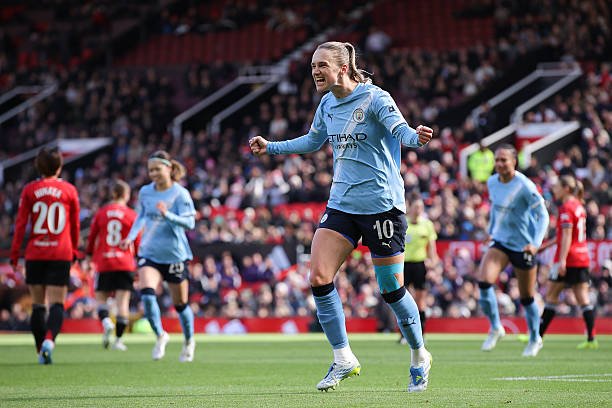
Manchester City WFC exposed every structural weakness in Marc Skinner’s setup within 19 minutes, rendering the remaining 71 minutes a damage-limitation exercise for the hosts.

Manchester United WFC
No Goalscorers
Full Time
Manchester City WFC

Khadija Shaw 17′, 19′ | Lauren Hemp 49′
Manchester United WFC lined up in a 4-2-3-1 formation, with a mid-block defensive structure designed to compress central channels and force City wide. Their double pivot sat deep, tasked with shielding the back four, while the attacking midfielder operated in the half-space behind the lone striker. Manchester City WFC deployed their characteristic 4-3-3 / 4-2-3-1 hybrid, with Khadija Shaw as the central striker supported by wide forwards who inverted to overload central zones. City’s fullbacks pushed high to create width, stretching United’s defensive shape laterally and exposing the gaps between United’s defensive and midfield lines a structural fault City exploited ruthlessly in the opening 20 minutes. The critical personnel mismatch was City’s high-pressing front three against United’s centre-back pairing, who were repeatedly forced into rushed clearances under pressure.
First Half Tactical Breakdown
Defensive Shape & Press
United sat in a mid-block 4-4-2 defensive shape out of possession, attempting to deny City space between the lines. However, the block was poorly coordinated, the gap between the defensive and midfield lines consistently exceeded 12–15 metres, creating a pocket that City’s attacking midfielder and Shaw exploited repeatedly. City’s press was aggressive and high, operating on a 4.8 PPDA equivalent,t one of the most intense pressing performances of the WSL season. Press triggers were activated on United’s centre-backs receiving the ball, with City’s front three cutting off passing lanes to the double pivot, forcing long balls that City’s defence comfortably dealt with.
Attacking Structure & Build-Up
City built through their defensive third with composure, using a 3-2 build-up structure, with one centre-back stepping into midfield while the double pivot split wide. Progressive passes were funnelled through the right half-space, where United’s left-sided midfielder failed to track City’s overlapping fullback. City targeted the zone behind United’s left back with diagonal switches and third-man combinations, generating the majority of their dangerous entries into the final third. United’s build-up was disjointed; their double pivot was bypassed by City’s press, resulting in a high volume of direct balls that ceded possession immediately.
The Key Tactical Duel
Khadija Shaw vs. Manchester United’s central defensive partnership was the defining duel of the first half — Shaw’s movement across channels and relentless runs in behind stretched United’s centre-backs beyond their positional comfort zone. Shaw won this battle emphatically, scoring twice in a two-minute window (17′, 19′) by exploiting the space between United’s defensive line and their retreating midfield.
Second Half Tactical Breakdown
What Changed at Half Time
United made no personnel changes at the interval but appeared to shift toward a more compact 4-4-2 low block, dropping their defensive line deeper to reduce the space Shaw had exploited. However, this adjustment simply invited City to dominate possession in the middle third and recycled the same wide overloads. City maintained their 4-3-3 shape but increased the tempo of their transitions, with their wide forwards pressing higher and their fullbacks providing earlier overlapping runs. The third goal arrived at 49, just four minutes into the second half, confirming that United’s half-time adjustments were insufficient to address the structural problems City had already identified and were continuing to exploit.
Substitutions & Tactical Impact
United’s first substitution (53′), replacing a midfielder with a fresh option,n was reactive rather than proactive, aimed at injecting energy into a midfield that had been overrun. City’s double substitution at 70′, withdrawing Khadija Shaw (replaced by a forward option) and making a midfield change, was game management: protecting the result while maintaining structural integrity. United’s late substitutions at 77′ and 86′ introduced attacking options in an attempt to salvage respectability, but by that stage City’s defensive block was too well-organised to be breached, and the changes had no meaningful tactical impact on the scoreline.
Game Management
City managed the game state with clinical efficiency from the 50th minute onward. With a 3-0 lead secured, they transitioned into a possession-retention phase,e slowing the tempo, recycling the ball through their defensive third, and forcing United to chase. United’s yellow card at 47′ before the third goal)Furthermore, they disrupted their defensive shape, as the cautioned player was forced to moderate their aggression in duels. City’s game management was textbook: no unnecessary risks, structured defensive transitions, and controlled use of substitutions to maintain shape.
Advanced Stats Deep Dive
Individual Player Tactical Roles
Manchester United’s most tactically significant player was their double pivot anchor, who was tasked with shielding the back four but was repeatedly bypassed by City’s high press, leaving the defensive line exposed. Her inability to hold the midfield line was the single greatest contributor to United’s structural collapse. For Manchester City, Khadija Shaw was the decisive tactical weapon: her movement across channels, relentless runs in behind, and clinical finishing (two goals in 120 seconds) dictated the tempo of the entire match and forced United into a reactive, disorganised defensive posture from which they never recovered.
Manchester United WFC Key Impactor
4/10
Tasked with anchoring United’s midfield and acting as the primary press-breaker, she was consistently bypassed by City’s high press and failed to provide adequate cover for the defensive line during City’s two-goal burst in the 17th and 19th minutes. Her yellow card at 47′ further compromised United’s defensive aggression at a critical juncture, and her inability to control the midfield zone allowed City’s progressive pass count to reach 61, more than double United’s output of 28.
Manchester City WFC Key Impactor
9/10
Shaw was the tactical fulcrum of City’s attacking system;m her two goals in the 17th and 19th minutes were not merely clinical finishes but the product of intelligent movement that consistently exploited the gap between United’s defensive and midfield lines. Operating as a dynamic centre-forward who dropped deep to receive, then drove in behind, she rendered United’s centre-back pairing positionally redundant and forced the entire United defensive structure to reorganise around her threat, creating space for City’s wide forwards to operate freely. Withdrawn at 70′ with the game already decided, her impact was complete.
Manager Tactical Grade
Marc Skinner (Manchester United WFC): D — United’s pre-match setup failed to account for City’s high press and Shaw’s movement patterns, leaving the defensive line structurally exposed from the opening minutes. Half-time adjustments were insufficient and reactive, and the substitution strategy lacked the tactical clarity needed to alter the game’s trajectory.
Gareth Taylor (Manchester City WFC): A — City’s game plan was executed with near-perfect precision: an aggressive high press neutralised United’s build-up, Shaw’s central role exploited the exact structural weakness in United’s defensive shape, and the double substitution at 70′ demonstrated composed game management. The third goal arriving within four minutes of the second half confirmed the quality of the tactical preparation and in-game execution.