

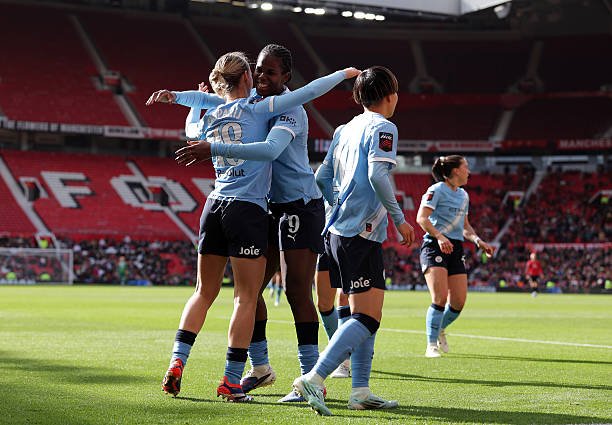
Manchester City WFC delivered a masterclass in clinical, possession-based football at Old Trafford, dismantling their cross-city rivals with a ruthless, composed performance that was never in doubt. Vivianne Miedema was the architect of destruction, netting twice in a devastating two-minute spell in the first half to put City firmly in the driving seat before the tie had barely begun. Kerstin Casparij added a third shortly after the interval to extinguish any lingering hope of a United comeback, with City’s 62.4% possession dominance and six shots on target telling the full story of their superiority. For Manchester United, it was a chastening afternoon on their own turf, one that exposed the gulf in quality between these two Manchester clubs at this stage of the WSL season.
First Half Report
From the first whistle, Manchester City made their intentions abundantly clear. Controlling 64.9% of possession in the opening 45 minutes, they suffocated United’s attempts to establish any rhythm in midfield, pressing high and recycling the ball with precision and purpose. United, set up in a compact defensive shape, looked to absorb pressure and hit on the counter, but the quality of City’s pressure,s led by the industrious Yui Hasegawa and Samantha Coffey in the engine room, om denied them any meaningful transition opportunities. The hosts managed just one shot in the entire first half, a stark illustration of how thoroughly City controlled the tempo and territory. Lauren Hemp was a constant menace down the left flank, stretching United’s defensive line and creating the width that allowed City’s central players to operate in pockets of space. Khadija Shaw’s physicality up front gave United’s backline, marshalled by Maya Le Tissier and Millie Turner,r a persistent aerial and pace threat to manage, while Aoba Fujino’s clever movement off the ball created constant problems in behind. City’s four first-half corners to United’s zero further underlined the territorial dominance that defined the opening period.
Goal & Key Moment Breakdown
The deadlock was broken in the 17th minute, and it arrived with the kind of quality that only the very best players in the world can produce. Alex Greenwood, City’s imperious captain and orchestrator from deep, played a perfectly weighted ball into the channel that dissected United’s defensive line with surgical precision. Vivianne Miedema, arriving with her trademark intelligent run, took the pass in her stride and finished with composed authority past Phallon Tullis-Joyce. This goal encapsulated everything City had been building towards in the opening quarter-hour. The celebrations had barely subsided when City struck again just two minutes later in the 19th minute. This time it was Kerstin Casparij who provided the creative spark, driving forward from her right-back position with characteristic energy and delivering a low, incisive ball into the box. Miedema was there again in the right place, at the right time, with the right finish to double City’s advantage and effectively end the contest as a competitive spectacle before the 20-minute mark. Two goals in two minutes at Old Trafford; it was a devastating, demoralising double blow that United had no answer to. City had four big chances in the match overall, and their first-half dominance in shots on target,t five to United’s zero, illustrates just how one-sided the opening period truly was.
First Half Talking Points
The standout performer of the first half was unquestionably Vivianne Miedema, who looked sharp, hungry, and utterly unplayable in the spaces between United’s midfield and defence. Her movement was a constant headache for Le Tissier and Turner, and her finishing was characteristically ruthless. Greenwood was magnificent in her deeper role, dictating tempo and spraying passes with authority, while Casparij’s assist for the second goal underlined her importance as an attacking outlet from right-back. For United, goalkeeper Phallon Tullis-Joyce was kept busy making saves to prevent the scoreline from becoming even more embarrassing before the interval, and she deserves credit for keeping City to two when the statistics suggested it could have been more. United’s midfield trio of Malard, Miyazawa, and Naalsund were overrun and unable to assert any control, and the half-time dressing room would have been a sombre place for Marc Skinner’s side. City went into the break with a commanding 2-0 lead, a clean sheet, and every reason to believe the second half would be equally comfortable.
| First Half Stats | Manchester United WFC | Manchester City WFC |
|---|---|---|
| Possession | 35.1% | 64.9% |
| Shots | 1 | 10 |
| Shots on Target | 0 | 5 |
| Corners | 0 | 4 |
| Fouls | 3 | 6 |
| Bookings | 0 | 0 |
Second Half Report
Manchester United emerged from the half-time interval with a greater urgency and a noticeably higher defensive line, clearly tasked with pressing City higher up the pitch and attempting to win the ball back in more dangerous areas. Their possession share improved to 40% in the second half, a marginal but meaningful shift,t and their shot count of nine in the second 45 minutes compared to just one in the first tells the story of a team that at least attempted to respond. However, City were not about to sit back and allow United a foothold in the contest, and within four minutes of the restart, they had effectively killed the game stone. The tactical adjustments United made at the break were rendered irrelevant almost immediately, as City demonstrated that their first-half dominance was no fluke; it was the product of a well-drilled, tactically superior team operating at the peak of their powers.
Goal & Key Moment Breakdown
The third goal arrived in the 49th minute, and it was a moment of genuine quality. Lauren Hemp, who had been outstanding throughout, drove forward with purpose from the left and delivered a perfectly timed ball into the area. Kerstin Casparij, who had already provided an assist in the first half, arrived late into the box with a well-timed run and finished clinically to make it 3-0, a goal that reflected the full-back’s remarkable contribution across both halves of the contest. The timing of the goal was particularly crushing for United; they had barely had time to implement any second-half tactical adjustments before City had already extended their lead. With the game at 3-0 and barely two minutes of the second half elapsed, the contest was definitively over as a competitive fixture. United did manage to create their one big chance of the match in the second period,d a moment that drew a save from Ayaka Yamashi, ta but the Japanese goalkeeper was rarely troubled in any meaningful sense, making just two saves across the entire ninety minutes.
Substitutions Report
City manager Gareth Taylor made his first change in the 53rd minute, withdrawing the impressive Lea Schül, Ler, who had led United’s line with energy if not end product and introducing Fridolina Rolfö in her place. Wait, Schüller was in the United lineup; this was a United substitution, bringing on Rolfö to add fresh legs and directness to an attack that had been starved of service. The double substitution at the 70th minute saw City make their most significant tactical adjustments: Kerolin replaced the two-goal Miedem, a sensible decision to protect their star player with the game already won, while Layla Drury came on for United in place of Jayde Riviere, adding youthful energy to the right flank. City’s decision to withdraw Miedema was sound squad management; she had done her job emphatically. United’s double change at the 77th minute, Gabrielle George replacing Millie Turner, and Jessica Anderson coming on for Lisa Naalsun,d suggested a degree of reshuffling for the final quarter, with the result beyond doubt. City’s final change saw Mary Fowler introduced for Lauren Hemp in the 86th minute, a routine rotation to protect the winger who had been instrumental throughout. Overall, City’s substitutions were measured and professional; the changes of a team managing a comfortable victory, while United’s alterations felt reactive rather than game-changing.
Final Stages
The closing stages of the match were largely uneventful in terms of genuine drama, with City content to manage possession and see out a comfortable victory. United, to their credit, continued to press and created a handful of second-half opportunities, their nine second-half shots representing a more spirited showing than the first half,f but a lack of cutting edge and the quality of City’s defensive organisation meant Yamashita was never seriously tested. Rebecca Knaak had already been booked in the 47th minute for a foul,u Ul City’s only ycard of the afternoon, and the visitors were disciplined enough to avoid any further disciplinary issues as they closed out the game. The final whistle confirmed a comprehensive, authoritative Manchester City victory that flattered United in the sense that the scoreline could quite easily have been more emphatic.
| Second Half Stats | Manchester United WFC | Manchester City WFC |
|---|---|---|
| Possession | 40% | 60% |
| Shots | 9 | 5 |
| Shots on Target | 2 | 1 |
| Corners | 1 | 3 |
| Fouls | 3 | 5 |
| Bookings | 0 | 1 |
Full Match Stats
| Stat | Manchester United WFC | Manchester City WFC |
|---|---|---|
| Possession | 37.6% | 62.4% |
| Shots | 10 | 15 |
| Shots on Target | 2 | 6 |
| Shots Off Target | 7 | 7 |
| Blocked Shots | 1 | 2 |
| Big Chances | 1 | 4 |
| Big Chances Missed | 2 | 2 |
| Corners | 1 | 7 |
| Offsides | 0 | 4 |
| Fouls | 6 | 11 |
| Yellow Cards | 0 | 1 |
| Red Cards | 0 | 0 |
| Passes Completed | 282 | 496 |
| Pass Accuracy | 82% | 87% |
| Aerials Won | 9 | 11 |
| Tackles Won | 11 | 10 |
| Saves | 3 | 2 |
Player Ratings
6.5
Made three saves across the ninety minutes and was arguably United’s best performer on a difficult afternoon. Kept the scoreline from becoming even more embarrassing with a series of competent stops, though she was ultimately powerless against Miedema’s clinical finishing in the first half.
5.5
Faced a difficult afternoon dealing with the movement and pace of Aoba Fujino and the overlapping runs of Casparij. Contributed to United’s tackle count but was often caught too deep to offer any meaningful attacking outlet down the right flank.
5.0
Struggled to contain Miedema’s intelligent movement in the first half and was caught out of position for both early goals. Substituted in the 77th minute, her departure reflecting a difficult personal performance against one of the WSL’s most technically gifted forwards.
5.5
The more composed of United’s central defensive pairing, Le Tissier contributed to the aerial battle — United won nine aerials overall — and showed leadership in attempting to organise the backline. However, City’s movement and quality of service ultimately proved too much to handle consistently.
5.5
Riviere had a mixed afternoon on the left side, tasked with containing the dangerous Lauren Hemp who was a constant threat throughout the first half in particular. Substituted at the 70-minute mark for Layla Drury, her removal signalling a tactical reshuffle as United sought fresh legs.
5.0
Malard was unable to impose herself on the contest in the way United needed from their most creative midfielder. Overrun by City’s press in the first half, she showed more enterprise after the break as United’s possession improved, but her influence on the game remained frustratingly peripheral throughout.
5.5
The Japanese midfielder worked tirelessly in the centre of the park and contributed to United’s tackle count, but found herself constantly outnumbered against Hasegawa and Coffey’s dominant midfield pairing. Her work rate was commendable even as the game slipped away from her side.
5.0
Naalsund struggled to find her rhythm in a midfield that was comprehensively outplayed for large portions of the contest. Her inability to win the ball back in key areas allowed City to maintain their suffocating possession dominance, and she was replaced by Jessica Anderson in the 77th minute.
5.5
Park showed flashes of quality on the wing and contributed to United’s improved second-half attacking output, helping generate some of the nine second-half shots. However, she was starved of service for long periods and was unable to create the clear-cut chances United desperately needed to mount any kind of comeback.
5.0
Awujo had a frustrating afternoon with minimal service and was unable to make any meaningful impact against City’s well-organised defensive unit. She worked hard without the ball but was isolated for much of the contest, a symptom of United’s wider inability to build from midfield and create meaningful attacking opportunities.