
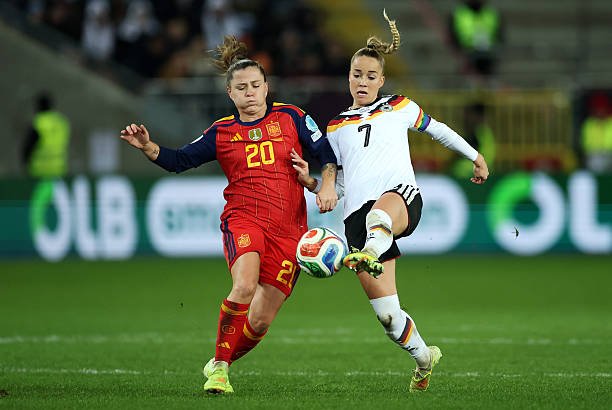
The UEFA Women’s Nations League reaches its climax tomorrow night as World Champions Spain welcome Germany to the Metropolitano Stadium for the second leg of the final. Following a tense 0-0 draw in the opening encounter, the trophy remains firmly in the balance.
Spain, buoyed by home advantage and the momentum of their recent global triumph, will look to impose their trademark technical precision and fluid attacking play. Germany, meanwhile, arrives with confidence in their defensive organisation and counter-attacking efficiency, qualities that have long defined their success on the international stage.
With two of Europe’s most decorated sides facing off, the contest promises high drama, tactical intrigue, and moments of individual brilliance that could ultimately decide the outcome. For both nations, victory would mark a significant milestone in their pursuit of continental supremacy.
A Rivalry Defined by Fine Margins
The history between Spain and Germany in women’s football is one of evolving dynamics, shifting from German dominance to Spain’s recent ascendancy. Germany once held a clear edge, but Spain’s triumphs, including their World Cup victory and a hard-fought extra-time win in the UEFA Women’s Euro 2025 semi-final, have tilted the scales. The first leg’s goalless stalemate only heightens the anticipation, echoing the tight, often low-scoring affairs that characterize this matchup. Here’s a look at their recent head-to-head encounters:
| Date | Competition | Result |
|---|---|---|
| 28 Nov 2025 | UEFA Nations League – Women | Germany W 0-0 Spain W |
| 23 Jul 2025 | UEFA Championship – Women | |
| 09 Aug 2024 | Olympics Women | |
| 12 Jul 2022 | UEFA Championship – Women | |
| 12 Jun 2019 | World Cup – Women |
These results underscore the razor-thin margins: four of the last five meetings have been decided by a single goal or ended in a draw, with extra time required in one instance.
Detailed Recap of the First Leg in Kaiserslautern
The first leg, played on November 28, 2025, at the Fritz-Walter Stadion in Kaiserslautern, Germany, before a crowd of 40,159, was a masterclass in defensive organization and missed opportunities. Germany, hosting the opener, started sluggishly but grew into the game, dominating the first half with relentless pressure and creating a flurry of chances beginning around the 25th minute.
Klara Bühl was the standout for the hosts, firing a close-range shot that was saved by Spain’s goalkeeper Cata Coll early on, followed by another effort blocked and a low drive that struck the woodwork in the second half. Ziska Kett had a golden one-on-one opportunity denied by Coll’s legs, while Jule Brand’s goal-bound effort was dramatically cleared off the line by Spain captain Irene Paredes. Nicole Anyomi also threatened, firing just past the post, and Rebecca Knaak saw a set-piece chance punched away by Coll.
Spain, content to absorb pressure and counter, struggled to assert their possession-based style in the opening period but improved after the restart. Eight minutes into the second half, Esther González nearly broke the deadlock, latching onto Mariona Caldentey’s cross and hitting the post with Germany goalkeeper Ann-Katrin Berger beaten. Alexia Putellas added a deflected shot that went wide, signaling Spain’s growing intent. However, Germany regained control, with Brand’s cross-shot clipping the woodwork and substitute Shekiera Martinez skewing a late half-chance wide from distance in stoppage time after Coll blocked Sjoeke Nüsken’s effort.
Tactically, Germany focused on wing play and set-pieces, forcing Coll into six crucial saves and exposing Spain’s defensive vulnerabilities on transitions. Spain, meanwhile, prioritized solidity, with Paredes’ clearance proving pivotal, and appeared satisfied with the away draw, leaving them well-positioned for the return leg. The match highlighted Germany’s attacking potency but poor finishing, while Spain’s resilience kept them in the tie despite being second-best for long stretches.
Form and Tactical Outlook
Both teams enter the decider in impressive form, but the first leg’s dynamics will influence their approaches. Germany topped their League A Group A1 unbeaten (5W, 1D), scoring 26 goals and conceding just four, showcasing efficiency and defensive steel.
They advanced by edging past France in the semi-finals with a narrow 3-2 aggregate victory, securing a 1-0 win in the first leg at home before holding on for a 2-2 draw away despite a late French comeback. This gritty performance underlined their defensive resolve and ability to perform under pressure. Their recent run of DDWWW reflects a resilient side that thrives on organization and quick counters, as evidenced by their dominance in Kaiserslautern. Expect coach Christian Wück to stick with a compact setup, aiming to frustrate Spain’s rhythm while exploiting spaces with players like Bühl and Brand on the break. Spain, riding the momentum of their World Cup success, dominated Group A3 with 15 points from six matches (5W, 1L), netting 21 goals but conceding eight, highlighting a potent attack tempered by occasional defensive lapses.
They powered through the semi-finals by dismantling Sweden 5-0 on aggregate, cruising to a 4-0 victory in the first leg at home, followed by a 1-0 win away, where Alexia Putellas scored the decisive goal to wrap up the tie. Their fluid, possession-oriented football was disrupted in the first leg of the final, but at home, they can dictate the tempo more effectively. The Metropolitano’s passionate crowd could be a game-changer, amplifying their technical superiority and press. However, Germany’s ability to contain stars like Putellas in the opener suggests a blueprint for success: physical midfield battles and rapid transitions.
Prediction
This tie remains delicately poised after the first leg’s cagey affair. Germany’s defensive masterclass and chance creation give them hope, but playing away against a partisan Madrid crowd tips the balance toward Spain.
Prediction: Spain 0-1 Germany.