


FC Bayern München
F. Kett (69′)
Full Time
FC Barcelona

E. Pajor (8′)
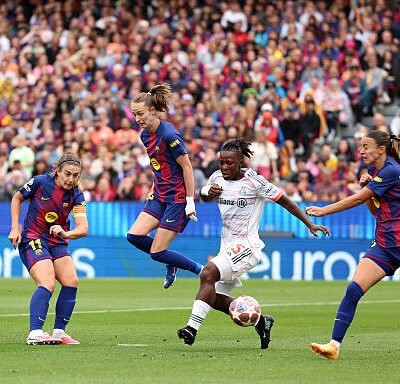
The structural contest was settled early. Barcelona’s 4-3-3 against Bayern’s 4-2-3-1 created a midfield mismatch that the Catalans exploited from the first whistle — three against two in the central corridor, persistent overloads, and no reliable mechanism for Bayern to break the press or recycle cleanly. The result was a game that never truly developed as a contest. Barcelona controlled 73.4% of the ball at 91% pass accuracy; Bayern managed 26.6% at 75%, and spent the majority of both halves in a reactive low-block that bore little resemblance to the attacking 4-2-3-1 they had set up in. In practice, it functioned as a 4-4-2 mid-block — a shape defined entirely by the opponent rather than by any tactical intent of their own
First Half Tactical Breakdown
Defensive Shape & Press
Bayern’s defensive passivity is quantified by a PPDA of 22.2 — a figure indicating they allowed Barcelona to complete over 22 passes per defensive action, confirming a deliberate low-block strategy with minimal press triggers. Their 3 high turnovers reflect isolated counter-press moments rather than a sustained high-press system. Barcelona, by contrast, operated a structured and aggressive press with a PPDA of 7.1, meaning they disrupted Bayern’s build-up every 7 passes — a high-intensity pressing scheme that consistently denied Bayern time and space in their own half. Their 4 high turnovers were a direct product of this organised press, generating dangerous transition opportunities in advanced zones.
Attacking Structure & Build-Up
Barcelona’s attacking dominance is underscored by 226 progressive passes versus Bayern’s 116 — nearly double the volume, reflecting sustained positional superiority and a structured build-up that consistently advanced the ball into dangerous areas. Their 42 touches in the box, compared to Bayern’s 19, confirm that Barcelona’s 4-3-3 generated sustained final-third penetration, with the wide forwards and inverted movements creating consistent box entries. Bayern’s 116 progressive passes and 19 box touches indicate their attacking output was limited to sporadic transitions rather than a coherent positional build-up, with the 4-2-3-1’s attacking midfielder largely isolated and unable to link play effectively under Barcelona’s pressing structure.
The Key Tactical Duel
The most significant disciplinary flashpoint of the first half was Vicky López’s yellow card at minute 18, indicating an early tactical foul to disrupt a Barcelona attacking move — a reactive intervention consistent with Bayern’s low-block, foul-to-defend approach. Barcelona’s pressing structure won this duel: López’s booking confirmed Bayern were already being forced into cynical defensive actions to halt Barça’s progressive ball movement within the opening quarter of the match.
Second Half Tactical Breakdown
What Changed at Half Time
The possession split shifted marginally at half-time — Bayern moved from 26.6% to 26.9%, while Barcelona adjusted from 73.4% to 73.1% — figures so negligible that no fundamental tactical reorganisation occurred at the interval. Bayern’s structural problem remained unchanged: their 4-2-3-1 continued to function as a passive defensive block, unable to sustain possession phases long enough to build meaningful attacking sequences. Barcelona maintained their 4-3-3 positional structure without alteration, continuing to exploit the same central overloads and wide channels that defined the first half.
Substitutions & Tactical Impact
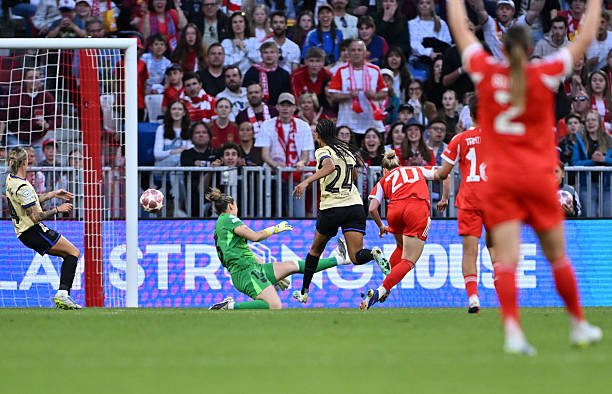
Bayern’s equaliser arrived at minute 69 via F. Kett. A. Caruso entered for K. Bühl at minute 75 — within 6 minutes of the goal, narrowly outside the 5-minute threshold — and does not qualify under the criteria. No substitution was made within 5 minutes before the minute 69 goal, no substitute directly scored or assisted either goal, and no substitution triggered a verifiable major formation change. Substitutions made in the second half did not fundamentally alter the tactical flow or directly impact the scoreline.
Advanced Stats Deep Dive
| Metric |
FC Bayern München |
FC Barcelona |
Significance |
|---|---|---|---|
| PPDA | 22.2 | 7.1 | Press intensity |
| Progressive Passes | 116 | 226 | Forward ball movement |
| Touches in Opp. Box | 19 | 42 | Final third presence |
| High Turnovers | 3 | 4 | Press success rate |
Individual Player Tactical Roles
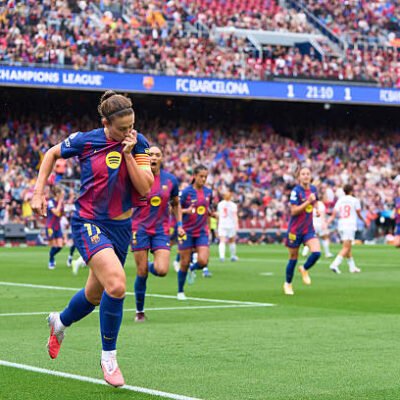
E. Pajor scored at minute 8, delivering Barcelona’s only goal of the match from an early attacking position that immediately placed Bayern’s defensive block under scoreline pressure. That early strike forced Bayern to abandon any residual ambition of a high press or structured build-up, locking them into a reactive defensive posture for the remaining 82 minutes. Pajor’s rating is supported by a base score of 6.0, boosted by a +1 goal contribution and +0.2 for key passes, alongside duels won — a profile confirming both finishing efficiency and hold-up involvement. While the goal itself did not secure the win, it exposed the fragility of Bayern’s 4-2-3-1 against a high-tempo early press and set the tactical terms of the entire contest. K. Bühl operated on Bayern’s flank as one of their primary ball-carriers and dribble threats, registering top touches and dribble attempts in a match where Bayern’s attacking output was severely restricted. Her presence forced Barcelona’s fullback into repeated defensive engagements, providing Bayern’s only consistent mechanism for advancing possession into the final third. Her data — a base of 6.0 with +0.6 for key passes, +0.1 for dribbles, and duels won — reflects a player who worked hard within a structurally limited system to generate attacking moments. However, her performance, while industrious, could not overcome the systemic possession deficit imposed by Barcelona’s 4-3-3, and ultimately did not prevent Bayern from being outplayed across all territorial metrics.
FC Barcelona Key Impactor
7.2
Pajor’s minute-8 goal — backed by a +1 goal contribution, +0.2 key passes, and duels won — immediately destabilised Bayern’s defensive structure and forced them into a passive low-block for the remainder of the match. Her early strike was the single most consequential tactical event of the contest, exposing the vulnerability of Bayern’s 4-2-3-1 to direct, high-tempo attacking pressure in the opening exchanges.
FC Bayern München Key Impactor
6.7
Bühl was Bayern’s most active attacking outlet, recording top touches, dribble attempts (+0.1), and key passes (+0.6) — functioning as the primary mechanism for bypassing Barcelona’s press on the flank. Despite her industry, her performance could not compensate for Bayern’s systemic 26.6% possession share, and her impact ultimately exposed the extent to which Bayern’s attacking threat was concentrated in a single wide channel rather than distributed across a coherent structure.