


Brighton & Hove Albion WFC
M. Haley (47′), K. Seike (47′), M. Haley (65′)
Full Time
Manchester City WFC

Kerolin (5′), K. Shaw (86′)
Brighton’s 4-4-2 operated as a compact, low-to-mid block out of possession — two disciplined banks of four designed to compress central lanes and force City wide. In possession, Brighton were direct and vertical, bypassing City’s press with limited recycling. Their 44.3% possession share and 73% pass accuracy reflect a deliberate, efficiency-first approach rather than a structural deficiency. Manchester City’s 4-2-3-1 gave them the platform to dominate the ball — 55.7% possession and 78% pass accuracy — using the double pivot to circulate and probe. In possession, City’s wide fullbacks pushed high, creating a de facto 2-3-5 shape, with the No.10 operating as the link between midfield and attack. The structural mismatch was clear: City’s wider build-up vs. Brighton’s narrow defensive block created a persistent tension across both halves.
First Half Tactical Breakdown
Defensive Shape & Press
Brighton’s PPDA of 11.6 confirms a passive, organised defensive posture — they conceded the ball and defended in shape rather than pressing aggressively. Their 5 High Turnovers reinforce this: Brighton were not winning the ball in advanced zones. Manchester City, by contrast, pressed with intensity and purpose — a PPDA of 7.9 indicates a high-frequency, coordinated press that suffocated Brighton’s build-up. City’s 17 High Turnovers were a direct product of this pressure, repeatedly recovering possession in dangerous areas and pinning Brighton in their own half during extended first-half spells.
Attacking Structure & Build-Up
Brighton generated 142 Progressive Passes but managed only 18 Touches in the Box — a low conversion of forward ball into genuine final-third penetration. Their build-up was largely bypass football: long switches and direct balls that moved the play forward but failed to consistently unlock City’s defensive structure. Manchester City’s 164 Progressive Passes paired with 46 Touches in the Box tells a sharply different story. City’s positional superiority in the attacking third was sustained and systematic — their 4-2-3-1 created numerical overloads in wide channels, and the volume of box entries reflected a team that was not just moving the ball forward, but arriving in dangerous positions with regularity.
The Key Tactical Duel
The pivotal positional battle of the first half centred on City’s press vs. Brighton’s ability to play through it — a duel sharpened by C. Rule’s yellow card at minute 14, which forced Brighton into a more cautious defensive posture and constrained their press-breaking options. Kerolin’s yellow at minute 29 did not slow City’s attacking intent but did signal the aggression with which Brighton attempted to disrupt City’s forward runners. City won this duel comfortably, translating their pressing dominance into the opening goal through Kerolin at minute 5 before Brighton had time to settle.
Second Half Tactical Breakdown
What Changed at Half Time
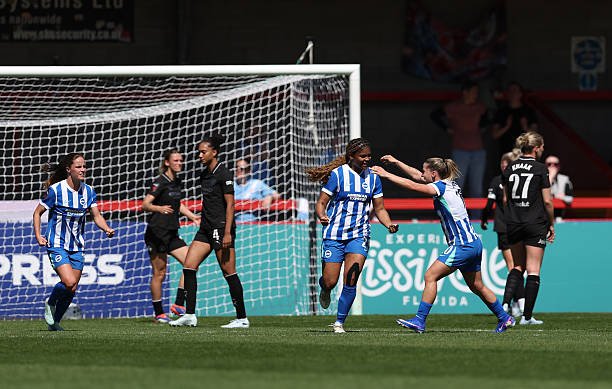
The possession split shifted marginally but meaningfully at half time: Brighton dropped further to 41.9% in the second half, with City climbing to 58.1%. Brighton appeared to deliberately cede even more territory, sitting deeper and compressing space in front of their box. This invited City to play in front of them but removed the high-press threat entirely. The tactical trade-off was calculated — Brighton sacrificed possession to protect defensive structure and exploit transitions. The immediate payoff was decisive: two goals in the 47th minute from M. Haley and K. Seike demonstrated that Brighton’s low-block, counter-attacking model was not passive by accident — it was a deliberate second-half trap.
Substitutions & Tactical Impact
R. McLauchlan came on at minute 46 in place of the booked C. Rule — a forced change that directly preceded Brighton’s two-goal burst at minute 47, removing a disciplinary liability and stabilising the defensive shape at a critical transitional moment. M. Fowler replaced Kerolin at minute 59, coming on with City chasing the game at 1-2 down; this substitution signalled a structural shift in City’s attacking intent, but Brighton responded with M. Haley’s second goal at minute 65 — scored just six minutes after Fowler’s introduction — exposing City’s transitional vulnerability during the tactical reshuffle. K. Shaw’s goal at minute 86 came five minutes after the double substitution of L. Coombs (on for A. Fujino, 81′) and N. Noordam (on for J. Čanković, 81′), suggesting City’s late personnel changes injected enough attacking energy to pull one back, though it proved insufficient to alter the result.
Advanced Stats Deep Dive
| Metric |
Brighton & Hove Albion WFC |
Manchester City WFC |
Significance |
|---|---|---|---|
| PPDA | 11.6 | 7.9 | Press intensity |
| Progressive Passes | 142 | 164 | Forward ball movement |
| Touches in Opp. Box | 18 | 46 | Final third presence |
| High Turnovers | 5 | 17 | Press success rate |
Individual Player Tactical Roles
M. Haley was the decisive attacking force for Brighton, scoring twice — at minutes 47 and 65 — to overturn a deficit and extend the lead at the most tactically sensitive moments of the match. Her goals forced Manchester City to abandon their structured 4-2-3-1 shape and chase the game, fundamentally shifting the tactical balance from City’s controlled possession game to Brighton’s preferred counter-attacking environment. Haley’s rating reflects a base of 6.0 boosted by two goals (+2) and positive contributions in dribbles and duels won, producing a match-defining individual output. Her brace was the single most decisive factor in Brighton’s victory, converting a disciplined low-block structure into three points. Kerolin gave City an early platform, scoring at minute 5 to set a dominant early tone and immediately testing Brighton’s defensive resolve. Her goal forced Brighton into a more conservative shape and temporarily validated City’s high-press, high-possession approach — but her yellow card at minute 29 and subsequent substitution at minute 59 removed City’s most dangerous attacking outlet at a critical juncture. Her rating reflects a base of 6.0 with a goal (+1), positive key pass and dribble contributions, and duels won, offset by the yellow card (-0.5). Ultimately, Kerolin’s early goal opened the match but her absence in the second half exposed a City attacking structure that could not sustain its threat without her.
Brighton & Hove Albion WFC Key Impactor
8.2
Haley’s brace at minutes 47 and 65 — both on the counter — directly exploited the transitional gaps created by City’s aggressive high line and forward-heavy shape. Her dribble and duel-winning data confirm she was a consistent physical and technical threat in transition, making her the fulcrum of Brighton’s counter-attacking system.
Manchester City WFC Key Impactor
7.1
Kerolin’s fifth-minute goal and positive key pass and dribble metrics made her City’s most dangerous attacking threat in the first half, consistently pulling Brighton’s defensive line out of shape. Her yellow card at minute 29 and removal at minute 59 proved costly — City’s attacking structure visibly deteriorated after her substitution, and they failed to replicate her level of penetration for the remainder of the match.