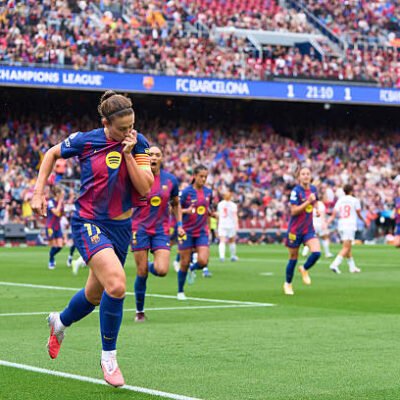


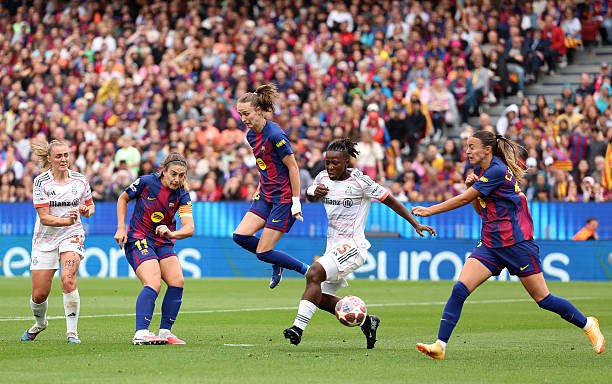
Salma Paralluelo’s 13th-minute opener was more than a goal. It was a demonstration of how Barcelona’s wide structure dismantles a compact defensive block. Caroline Graham Hansen, stationed on the right, had been pulling Bayern’s left-sided defensive shape toward her throughout the opening exchanges — each run and cut drawing a Bayern defender slightly out of position. When the cross arrived, Paralluelo was already arriving at the near post from a run Bayern’s defensive line had not tracked. The finish — left foot, top left corner from close range — required composure. But the chance required structure. Barcelona created it systematically.
Bayern’s response at minute 17 was the clearest indicator of what their tactical plan had been all along. Pernille Harder played Linda Dallmann through on a fast break — a direct, vertical move that bypassed Barcelona’s midfield entirely and exploited the space behind Barça’s high defensive line. Dallmann’s right-footed finish to the bottom left corner was clinical. It was also, in terms of quality of chance from open play, Bayern’s finest moment. The counter-attacking structure that produced it was the only viable approach against a team that compresses so much space in possession. The problem was Bayern could not sustain possession long enough to execute it consistently. Their 33% first-half share did not give them enough phases to build counters at volume.
Alexia Putellas restored Barça’s lead in the 22nd minute through the simplest possible mechanism: she found space in the central channel, received the ball from Graham Hansen, and drove a right-footed finish to the bottom right corner. What made it structurally significant was where the space came from. Georgia Stanway had been tasked — explicitly, based on her positioning — with tracking Putellas across the central zone. By the 22nd minute, Putellas had already drawn Stanway far enough to her right that the passing lane into the box from Graham Hansen was uncontested. Stanway was booked at minute 29 for a foul on Pajor — not coincidentally, as Bayern’s disciplined defensive shape collapsed under the pressure of trying to contain Putellas without conceding the space behind her movement.
Second Half Tactical Breakdown
Four Minutes That Closed The Tie
The second half’s defining sequence arrived within nine minutes of the restart. Ewa Pajor’s headed goal at minute 54 — arriving unmarked at the far post from Paralluelo’s cross — was the product of the same wide pressure that had produced the opener in the 13th minute. Bayern’s defensive block had shifted to track Barça’s midfield runners, leaving Pajor’s run from the striker’s position unmonitored. Then Putellas again at minute 58: a left-footed finish from inside the six-yard box, guided by a headed pass from Esmee Brugts following a set piece. Four minutes. Two goals. The aggregate was now 5-2 and Bayern faced the mathematical impossibility of needing three unanswered goals with thirty-two minutes remaining against a side that had conceded one all night.
Bayern replaced Stanway with Arianna Caruso at minute 61 — a direct acknowledgement that the booked midfielder was a disciplinary liability in a match they needed goals from. Within ten minutes, Pernille Harder converted at the other end, making it 4-2 after a Dallmann assist. The goal was a consequence of the midfield reset freeing Harder from the defensive responsibilities Stanway had been carrying — but it arrived as consolation, not catalyst. Barcelona’s response to the goal was immediate: Aitana Bonmatí entered at minute 68 alongside Vicky López, reinforcing midfield control at the precise moment Bayern had found a foothold and might otherwise have built momentum. Bonmatí’s introduction signalled that Barça’s coaching staff had identified the threat and neutralised it before it could develop into something meaningful.
Putellas was withdrawn at minute 86, yellow card noted, energy preserved for Oslo. The final act of the evening came when Harder thought she had made it 4-3 on the night — a 90th-minute goal overturned by VAR for a foul in the build-up. It denied Bayern the one result that might have given the aggregate a thread of drama. Barcelona were already in the tunnel mentally. The tie had ended at minute 58.
Advanced Stats Deep Dive
The big chances figure is the number that ends the argument. Eight big chances created by Barcelona to Bayern’s one. That is not a possession advantage converting into chance quality — that is a structural superiority converting into danger at a near 8:1 ratio. Bayern’s PPDA of 12.7 against Barça’s 8.4 shows that Barcelona were actively disrupting Bayern’s build-up in the press while Bayern were content to sit and absorb. The problem with sitting and absorbing against a team generating 44 box touches is that eventually the ball goes in — and it went in four times.
Bayern’s three high turnovers compared to Barça’s two looks, in isolation, like a Bayern advantage in press success. In context, it means nothing. Bayern recovered the ball in advanced areas on three occasions against a team that had 67% of the ball. The press success rate is low precisely because the ball was so rarely in Bayern’s territory. High turnovers are only meaningful when a team has enough possession to create them at volume. Bayern did not have the ball enough to press it.
Individual Player Tactical Roles
There is a version of this tactical analysis that focuses entirely on the 4-3-3 overload mechanics and reduces Putellas to a product of the system. That version is wrong. Putellas did not score twice at minute 22 and 58 because the system created open nets for her. She scored because she identifies the structural gaps the system creates faster than the defender tracking her can close them. Her first goal came from her recognition that Graham Hansen’s run had pulled Stanway two yards to the right — the pass from Graham Hansen arrived before Bayern’s back line could shift across. Her second came from a set-piece delivery that required her to arrive at the right spot, at the right angle, at the right time. Systems do not do that. Players do.
Harder’s performance deserves more than a line in a Bayern tactical post-mortem. She assisted Dallmann’s 17th-minute equaliser, scored a composed 71st-minute consolation, thought she had scored again in the 90th — overturned by VAR — and hit the crossbar from outside the box at minute 82. Across 90 minutes against one of the most dominant defensive structures in the women’s game, she was the only player in a Bayern shirt who consistently found ways to threaten in advanced areas. The problem was the system around her. Harder needs teammates in possession, in rhythm, and in advanced positions to unlock her best work. Bayern gave her the ball in transition and asked her to do the rest largely alone. That she came so close to making it relevant anyway is a reflection of individual quality that the 4-2 scoreline does not adequately credit.
 FC Barcelona Key Impactor
8.3
Two goals (22′, 58′) from central positions. Key passes, dribbles, and a yellow card that was the only indication Bayern’s defensive structure made any contact with her at all. Withdrawn at 86′ with the tie long settled and Oslo firmly in focus. The match’s defining individual performance.
 FC Bayern München Key Impactor
7.2
Goal (71′), assist (17′), crossbar (82′), VAR-disallowed goal (90′). Bayern’s only consistent source of structural disruption — operating largely in isolation against a back line that was never truly under sustained pressure. Her output was the maximum possible from a broken team system.
Verdict
What Barcelona Just Proved — And What Oslo Demands
Six consecutive UWCL finals. That is what Barcelona have now achieved. No women’s club in the history of this competition has sustained that kind of continental dominance across half a decade, and this performance confirmed that the system — the 4-3-3 positional structure, the midfield rotation, the relentless pressing intensity — is not diminishing. It is refined. Bayern’s 4-2-3-1 was not a poor tactical choice in a vacuum. Against most opponents in Europe, it is a functional structure that absorbs pressure and creates on transitions. Against Barcelona’s midfield overload, it was systemically inadequate before the first whistle.
Oslo is a different challenge entirely. OL Lyonnes do not defend with a 4-2-3-1 double pivot that can be outnumbered in central zones. They press with structural aggression, they transition with pace and directness through Melchie Dumornay and Kadidiatou Diani, and they have just eliminated the reigning champions — Arsenal — 4-3 on aggregate in a tie that tested their defensive composure at every stage. Lyon will not give Barcelona the 67% possession share Bayern gave them tonight. They will contest it.
That contest — the most decorated club in UWCL history against the dominant force of the modern era — is what the Oslo final offers. Barcelona’s structural superiority over Bayern tonight was compelling to watch and analytically clean to explain. The final will be neither of those things. It will be contested, physical, tactically contested from the first minute, and decided by margins that no possession split or PPDA figure will fully capture. That is exactly what the women’s game deserves at its highest stage