

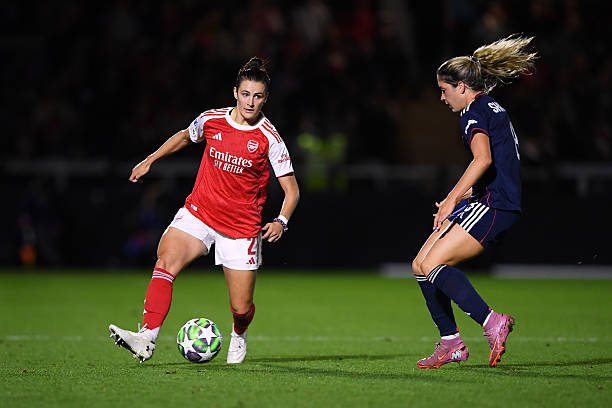
Arsenal WFC


OL Lyonnes
📅 April 26, 2026
📺 Kickoff: 14:30 UTC
GSI Signal
There is a brutal arithmetic to this UWCL Semi-final that no amount of home-crowd noise can fully obscure. Jonatan Giráldez Costas has faced Renée Slegers three times in his managerial career and won all three — a perfect, unbroken record that hangs over this tie like a storm cloud. Slegers, for her part, has yet to take a single point from those encounters. In the highest-stakes knockout round of the UEFA Women’s Champions League, where one aggregate swing separates glory from elimination, that psychological ledger matters enormously. Arsenal arrive at this semi-final on the back of a genuinely impressive run of form, but OL Lyonnes arrive as a machine that has been calibrated specifically — it seems — to dismantle them.
Tactically, the collision is fascinating. Arsenal’s expected setup will look to use their 54.8% average possession to build patiently and press with a PPDA of 11.9 — a moderate press that picks its moments rather than suffocating from the first whistle. Lyonnes, however, operate at a different atmospheric pressure entirely. Their PPDA of 8.5 signals a relentless, high-intensity press that actively hunts the ball back in advanced zones. With 64.8% average possession in UWCL play, Giráldez’s side doesn’t just want the ball — they demand it. The question is whether Arsenal’s build-up structure can survive that suffocation long enough to impose its own rhythm on a European semi-final stage.
Numbers That Matter
Team Intel
Current Form & Momentum Trajectory
Arsenal’s form sequence of LWWWWW tells a story of resurrection. That solitary defeat at the start of the run has been buried under five consecutive victories — a streak that speaks to a team that has found its footing and is building genuine momentum heading into this UWCL semi-final. Slegers has clearly steadied the ship, and the confidence coursing through the squad right now is real. OL Lyonnes’ WLWWDW is slightly more complex to read. The loss and the draw interrupt what would otherwise be a dominant run, and those dropped moments suggest Giráldez’s side is not entirely impervious — there are windows, however brief, where they can be caught. The challenge for Arsenal is engineering those windows deliberately, rather than waiting for Lyonnes to gift them.
Standings Pressure & What This Means
This is not a match where points are accumulated — it is a match where legacies are written. A UWCL Semi-final carries a weight that no domestic fixture can replicate, and both clubs understand precisely what is at stake. For Arsenal, reaching the final of the UEFA Women’s Champions League would represent the pinnacle of Slegers’ tenure and validate the project she has been building. The pressure of the home leg — the expectation of a crowd willing them forward — is both a gift and a burden. For Lyonnes, this is familiar territory; they are a club that has made the UWCL its personal domain across multiple eras. Giráldez will demand his players treat this as business as usual, channelling that institutional confidence into clinical execution. The psychological asymmetry between a side hungry for a first final and a side that expects to be in the finals is one of the most compelling undercurrents of this tie.
Attacking Threat & Route to Goal
Arsenal’s attacking blueprint in the UWCL has been built on open-play creativity — their 16 open-play goals lead OL Lyon’s 13 in that specific metric, which is a genuinely surprising inversion given the respective possession profiles. With 54.8% average possession, Slegers’ side looks to build through the lines and create overloads in transition, generating 112 shots (62 on target) across the campaign. Their route to goal leans heavily on open-play combination play rather than set-piece delivery, with only 3 set-piece attempts recorded. Granular data on individual positional rotations and specific focal players is not available in the current data feed, which limits deeper player-level analysis. Lyonnes, meanwhile, weaponise their 64.8% possession dominance to suffocate opponents in their own half, generating 168 shots (67 on target) — the sheer volume of their attacking output is relentless. Their 13 open-play goals from that volume suggest a slightly lower conversion rate than Arsenal, but the sustained pressure they apply makes their attacking threat cumulative and exhausting to defend against. Specific player-level contribution data for Lyonnes is also not available in the current data feed.
Defensive Shape & Vulnerability
Arsenal’s defensive record in the UWCL raises legitimate concerns ahead of this semi-final. Having conceded 106 total shots — 27 of them from inside the box — with zero clean sheets, the Gunners’ backline has been consistently penetrated at the highest level. Their tackle success rate of 66.44% is solid but not elite, and a PPDA of 11.9 means their press is not aggressive enough to consistently prevent opponents from building into dangerous areas. The blueprint for Lyonnes is clear: dominate possession, circulate the ball into the final third (where they already average 2,505 touches), and force Arsenal into repeated defensive actions until the structure cracks. Lyon’s own defensive record is a different universe — 45 total shots conceded, with only 12 from inside the box and zero clean sheets recorded. That inside-box figure is extraordinary; it means opponents are largely kept to peripheral, low-probability efforts. Arsenal will need to find a way to penetrate centrally rather than shooting from distance. Specific transitional vulnerability tracking for both sides is unavailable in the current data feed.
The X-Factor / Fixture Decider
The number that no heat map or expected goals model can fully capture is this: Jonatan Giráldez Costas has never lost to Renée Slegers. Three games, three wins, zero dropped points. In a UWCL knockout tie, that kind of managerial head-to-head dominance is not merely a footnote — it is a live tactical variable. Giráldez has clearly identified and exploited specific patterns in how Slegers’ teams set up, and there is no evidence yet that those solutions have been cracked. The burden falls on Slegers to produce something genuinely new — a wrinkle, a shape, a pressing trigger that Giráldez has not seen from her before. If she cannot, the historical pattern suggests Lyonnes will find a way through. No notable penalty data is available for either side in the current data feed, so that avenue of analysis cannot be pursued further.
Head-to-Head
Arsenal WFC OL LyonnesWhat makes the H2H record between these two sides so compelling is not the overall tally — it is the violent swings within it. This is not a rivalry defined by narrow, grinding results. It is defined by explosions. Arsenal’s 5-1 demolition of Lyon in October 2022 remains one of the most emphatic results in recent UWCL history between top-tier clubs, and yet Lyon responded in the very same group stage with a 1-0 win at the Emirates. Fast forward to April 2025, and Arsenal produced another stunning away performance — a 4-1 win in Lyon — only for Lyonnes to immediately recalibrate and win 2-1 at Arsenal six months later. The pattern that emerges is one of volatile, high-stakes reversals: neither side has found a way to consistently dominate the other across a full campaign, and away performances have repeatedly defied home advantage. All five meetings have come in the UEFA Women’s Champions League, which means both squads carry deep institutional memory of each other in this specific competition. That familiarity cuts both ways — Lyon knows how to hurt Arsenal, but Arsenal have proven they can produce seismic results when the moment demands it. The question is which version of this fixture shows up on semi-final night.